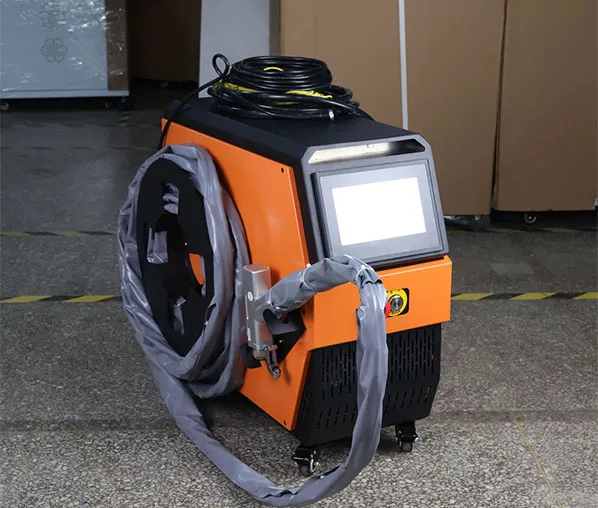
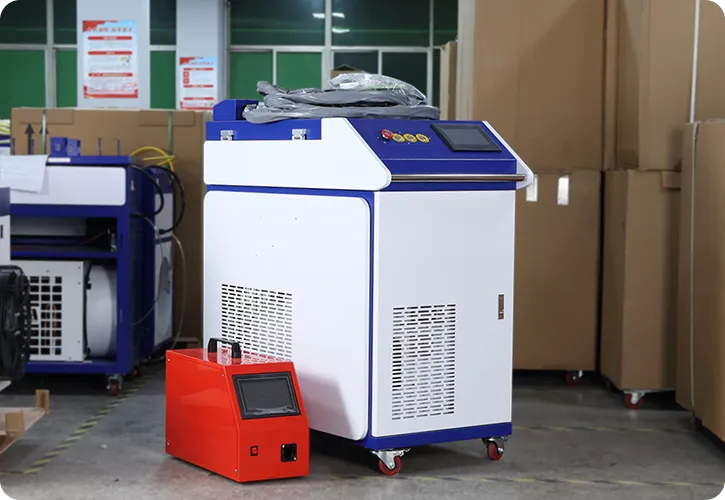
Production deadlines keep getting tighter, yet traditional welding still eats time with spatter, grinding, and rework. That slows delivery and frustrates customers. A handheld air-cooled laser welding machine fixes this by focusing heat where it matters, so you weld faster with cleaner seams—without dragging a heavy chiller around.
A portable air-cooled laser welding machine is a compact máquina de soldadura por laser that uses a focused laser beam (typically from a fiber laser) to weld metal with high speed and low distortion—often with optional cleaning and cutting functions. Jobon Laser’s air-cooled lineup (800–2000W, 1–5mm) is designed for global B2B shops that want proven results, fast lead times, and stable long-term service.
What is a laser welding machine, and why is air-cooled laser welding growing fast?
A máquina de soldadura por laser uses a concentrated laser beam to melt and join materials along a seam. In plain words: it heats a very small area, very quickly, and that helps you control distortion. This welding process is known for high speed and minimal distortion in advanced manufacturing.
So why does air-cooled matter so much right now? Because many global B2B workshops want mobility. They don’t want to move big parts to a welding cell, and they don’t want the complexity of a bulky water cooling setup. An air-cooled laser welding machine is easier to move, faster to deploy, and often simpler to maintain—especially for repair work, fabrication, and mixed-part jobs.
At Jobon Laser, we built this category around what overseas buyers ask for most: verifiable results, stable performance, and a portable design. Our Handheld Air-cooled Laser Welding Machine line is designed for 800–2000W output, with real factory features like wheels + brake, a comfortable handheld gun, and quick setup for on-site work.
Air-cooled vs water cooling: which air-cooled laser welding machine fits your shop?
Buyers ask this every week: air-cooled vs water cooling—which is better? The honest answer is: it depends on duty cycle, ambient temperature, and how portable you need the system to be.
Most comparisons agree on the core trade-off: water systems remove heat more efficiently, while air cooling tends to be easier and lighter but can be limited at very high duty cycles.
That’s why an air-cooled system is often the “best first step” for workshops that value mobility and quick deployment, while a water-cooling system may suit long, heavy, nonstop production.
| Shop Reality |
Better Choice |
Why |
| You weld different parts all day and move often |
Air-cooled |
Compact and portable, fewer external components |
| You run long welding sessions nonstop |
Arrefecimento a água |
Higher cooling headroom for long-term welding |
| You do on-site welding and repair |
Portable air-cooled |
Easy transport, fast setup |
| Your environment is hot and dusty |
Depends |
Air cooling needs good airflow; water cooling needs clean water loop |
I like to say it this way: air cooling laser welding machine designs win when your job is “move, weld, move again.” Water cooling wins when your job is “weld all day without pause.”
How does fiber laser technology improve weld quality and welding speed?
A modern máquina de soldadura por laser often uses a fiber laser because fiber sources are stable and efficient for industrial use. In simple terms, fiber delivery helps keep the beam quality tight, which supports precision welding and consistent seams.
Industry overviews commonly highlight fiber laser welding benefits such as higher precision, higher speed, and better weld quality compared with many conventional processes.
That doesn’t mean every part becomes perfect instantly—but it does mean you can standardize results more easily across operators.
Case study: how an air-cooled laser welder reduced rework for a sheet-metal workshop
Customer type: sheet metal / hardware workshop
Problema: too much grinding, inconsistent seam appearance, slow delivery
Old method: mostly traditional welding on visible stainless parts
Goal: improve output and finish without hiring more skilled labor
What they changed
They adopted an air-cooled laser welding machine because they needed mobility—moving between cabinets, frames, and distribution boxes. They used a simple fixture and standardized settings for each part. Their team also used cleaning mode to prep weld areas.
The practical results
- Improved seam appearance and reduced finishing labor
- Less distortion on thin panels (fewer fit-up issues)
- Faster throughput with repeatable settings
This matches a broad industry understanding: laser welding can reduce distortion due to its focused heat input.
What support should you demand from a factory-direct laser equipment supplier?
This is where many deals are won or lost.
A laser welding machine is not a disposable tool. If you sell it into a factory, the buyer expects uptime. So overseas customers usually demand:
- Sample testing (prove weld quality on their material)
- Inspection records before shipment
- Compliance-ready documents
- Fast lead time and fast response
- Training and spare parts support
Jobon Laser is structured exactly for these concerns. We’re a factory-direct supplier with R&D and manufacturing in industrial laser equipment, and our overseas customer base is manufacturing-driven: metal fabrication shops, automotive parts producers, electronics and appliance makers, integrators, and distributors.
FAQs
What is the main benefit of an air-cooled laser welding machine?
The biggest benefit is mobility and simplicity. An air-cooled unit avoids a heavy chiller, which makes it easier for on-site and mixed-part work. It’s a practical choice when your team moves between jobs throughout the day.
Is a portable air-cooled laser welding machine strong enough for production?
Yes—when matched to the correct thickness and joint design. Jobon Laser’s configuration targets common fabrication needs (1–5mm range depending on material), with stable output and predictable settings.
Do I need air-cooled or water cooling for long daily shifts?
If you run nonstop high duty cycles, water cooling can offer more thermal headroom. If you need mobility and fast setup, air-cooled is often the better fit. Many comparisons highlight this trade-off.
What’s the best way to confirm weld quality before I buy?
Always request sample testing using your real material and joint type. That’s the fastest way to verify weld quality and speed on your parts.
Can an air cooled laser welder also clean and cut?
Some models support multi-function work modes such as surface cleaning, cutting, and weld seam cleaning. This can reduce tool switching and improve workflow efficiency.
Is laser welding safer than arc welding?
Each process has different risks. Laser systems can create serious eye hazards from direct and reflected beams, so proper training and protection are mandatory. OSHA highlights these hazards clearly.
Key takeaways
- A laser welding machine uses a focused laser beam to concentrate heat, often reducing distortion and cleanup.
- Air-cooled designs are popular for mobility, fast setup, and compact workshop use.
- Choose an air-cooled laser welding machine when you need portability; consider water cooling for extreme duty cycles.
- Standardize welding parameters to improve repeatability and reduce rework.
- For B2B buyers, sample testing + inspection + after-sales support matters as much as specs.
- Jobon Laser supports global buyers with factory-direct supply, customization, fast response, and long-term service.











 10:38
10:38