











1500W vs 2000W vs 3000W vs 6000W Laser Welding Machine: Which Power Do You Need?
Choosing between a 1500W vs 2000W vs 3000W vs 6000W laser welding machine should start wit…
 14:09
14:09 Many buyers know they need a laser cleaning machine, but they do not know whether to choose CW or pulsed laser cleaning. Choose wrong, and you may waste money, clean too slowly, or damage the surface. The right choice starts with your material, rust level, and working area.
A CW laser cleaning machine is better for high-speed removal of heavy rust, thick paint, and large metal surfaces. A pulsed laser cleaning machine is better for precision cleaning, mold cleaning, thin parts, and lower heat impact. For pulse models, 100W–200W suit fine cleaning, 300W suits portable general cleaning, while 500W–1000W suit faster and heavier industrial cleaning.
When customers ask us about laser cleaning machines, they often ask one question first: “Which power should I buy?” Soon after, another question appears: “Should I choose CW or pulsed?” These are good questions. They also show the real problem: buyers are not only comparing machine price. They are trying to understand the relationship between laser power, cleaning speed, surface effect, and long-term cost.
A metal fabrication workshop may need to remove rust before welding. A mold factory may need careful residue cleaning without damaging fine details. A machinery repair company may need to remove thick paint from large steel parts. These jobs all require cleaning, but they do not require the same laser cleaning machine.
That is why this guide explains CW laser cleaning, pulsed laser cleaning, and 100W, 200W, 300W, 500W, and 1000W power choices in a practical way. Our goal is simple: help you choose a machine that can clean your real workpieces safely, efficiently, and economically.
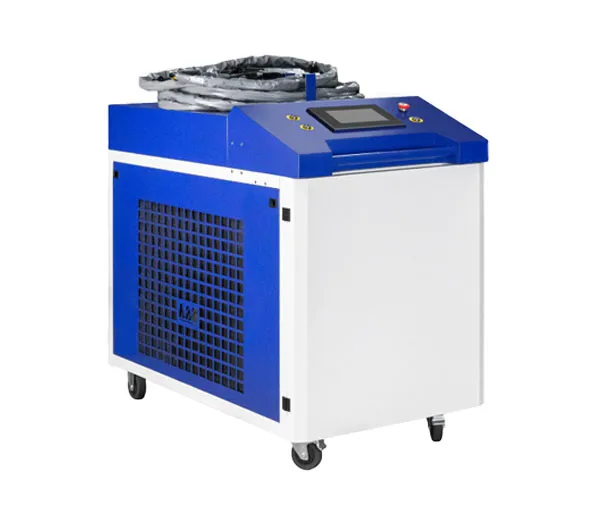
A CW laser cleaning machine uses a continuous laser beam to clean the surface. “CW” means continuous wave. The laser output stays steady during cleaning, which makes it suitable for fast removal on large or heavily contaminated surfaces.
CW cleaning is often used for:
Because CW systems deliver continuous laser energy, they usually offer strong cleaning speed on heavy layers. If your main goal is to remove rust quickly from large carbon steel surfaces, a CW system may be a practical and cost-effective choice.
However, CW cleaning also brings more heat input. For thin parts, precision molds, sensitive materials, or surfaces where the base material must be protected carefully, a CW system may not be the best option. In these cases, a pulse laser cleaning machine is often safer and more controlled.
Jobon Laser’s CW laser cleaning machine models include:
| CW Laser Cleaning Machine Model | Typical Use Direction |
|---|---|
| ZB-QX1500 | General industrial rust and paint removal |
| ZB-QX2000 | Faster cleaning for medium-to-large metal surfaces |
| ZB-QX3000 | Heavy rust, paint, and oxide removal |
| ZB-QX6000 | High-power large-area industrial cleaning |
For buyers who care about equipment budget, CW machines are often more affordable than pulsed machines in machine price. But there is another point to consider: CW machines are usually larger and heavier, so shipping cost may be higher.
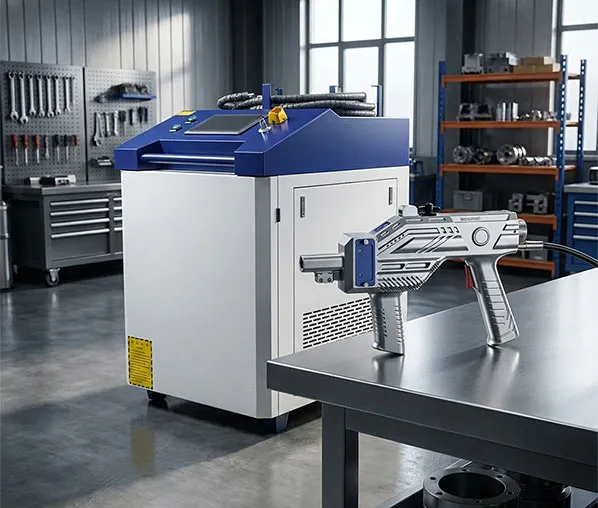
A pulsed laser cleaning machine uses short laser pulses instead of a continuous beam. These pulse lasers send energy to the surface in very short bursts. The rust, paint, oil, oxide, or coating layer absorbs the energy and separates from the base material.
The biggest advantage of pulsed laser cleaning is control. The machine can clean the surface with lower heat impact, which helps reduce the risk of surface damage. This makes it suitable for precision cleaning, mold cleaning, thin metal parts, fine surface treatment, and selective cleaning.
A pulsed laser cleaner is often used for:
If your cleaning job needs accuracy instead of only speed, pulsed laser cleaning is usually the better choice. It is especially useful when you need to protect the base material.
A buyer should not simply ask, “Which machine is better?” A better question is: “Which machine is better for my application?” CW and pulsed laser cleaning machines serve different cleaning needs.
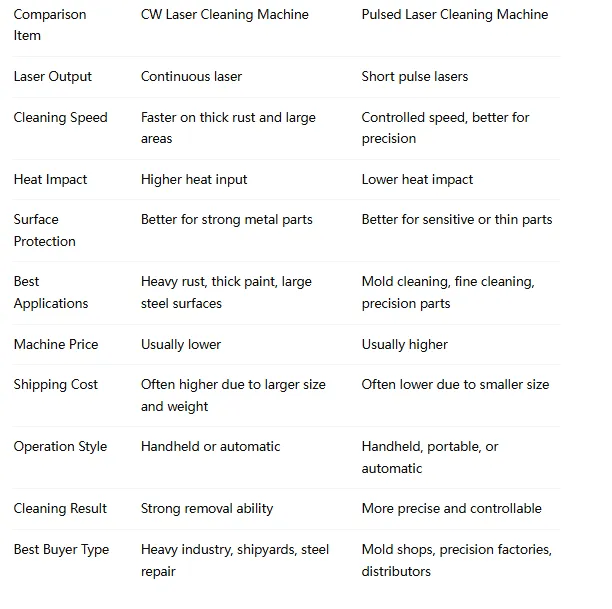
Laser cleaning has a higher initial investment, but it reduces consumables and can improve long-term cleaning efficiency. For factories that clean every day, this matters.
Cleaning speed is one of the most important factors for industrial buyers. A machine that cleans well but works too slowly may not fit production needs. This is why CW and pulsed cleaning must be compared by actual working conditions.
CW laser cleaning is usually faster for heavy rust, thick paint, and large steel parts. It uses continuous laser output, so it can remove surface layers quickly. For large-scale industrial cleaning, CW can be a strong choice.
Pulsed laser cleaning is more controlled. It may not always match CW speed on thick rust, but it provides better precision and lower heat impact. For molds, thin parts, tools, and valuable components, cleaning speed is not the only goal. Surface quality also matters.
A simple rule:
Heat impact is another key difference. CW laser cleaning uses continuous laser energy, so the heat input is higher. This can be useful for strong removal, but it may not be ideal for thin or sensitive materials.
Pulsed laser cleaning uses short pulse energy. Each pulse acts quickly on the surface layer. This helps control heat build-up and reduce the chance of surface damage. That is why pulsed cleaning is often used for molds, thin metal parts, precision parts, and applications where the original surface must stay stable.
For example, if you clean thick rust on a heavy steel frame, CW may work well. But if you clean a mold surface with fine texture, a pulsed laser cleaner is usually safer.
This is also why buyers should send sample materials before purchasing. A real cleaning test can show the surface effect, cleaning speed, and heat impact better than a product brochure.
Different materials react differently to laser energy. Carbon steel, stainless steel, aluminum, copper, molds, coated parts, and painted parts may need different power and settings.
CW cleaning works well on heavy-duty metal surfaces, especially when the base material is strong and heat tolerance is higher. It is often used for steel structures, ship components, large machinery, and thick rust removal.
Pulsed laser cleaning is better when the cleaning object is more delicate. For example, a mold with fine details, a thin stainless steel part, or a precision component may need lower heat and better control.
Many buyers think machine price is the only cost. It is not. A smart buyer should compare equipment price, shipping cost, consumables, maintenance, training, and working efficiency.
In many cases, CW laser cleaning machines are cheaper than pulsed laser cleaning machines. This is attractive for buyers who need strong cleaning power at a lower machine price.
But CW machines are usually larger and heavier. This may increase shipping cost, especially for overseas buyers. Pulsed machines often cost more at the equipment level, but they are usually more compact and easier to ship.
Long-term cost also matters:
So the best choice is not always the cheapest machine. It is the machine that gives the best total value for your cleaning process.
Choose CW laser cleaning when your main goal is strong and fast removal on large metal surfaces. If your workpieces are thick, strong, and not very sensitive to heat, CW may be the better choice.
CW laser cleaning is suitable for:
CW is also suitable when you want a lower machine price and can accept a larger machine body and higher shipping cost. For some factories, the lower equipment price can make CW more attractive.
However, if you work with molds, thin metal, high-value parts, or delicate surfaces, CW may be too strong. In that case, pulsed laser cleaning may be safer.
Choose pulsed laser cleaning when you need precision, lower heat impact, and better control. It is especially useful for cleaning tasks where surface quality matters.
Pulsed laser cleaning is suitable for:
A pulse laser cleaning machine is also a good choice for distributors because the machine is compact, easy to demonstrate, and suitable for many applications. For end users, pulsed cleaning can provide safer cleaning results on valuable parts.
If your customers often ask for “clean but do not damage the workpiece,” pulsed laser cleaning is usually the right direction.
This is the question many buyers really care about. They want to know the relationship between power and efficiency. In simple words: higher power usually means faster cleaning and stronger removal ability, but it also means higher cost and more need for correct settings.
100W: Fine Cleaning and Mold Details
A 100W pulsed laser cleaning machine is suitable for fine cleaning. It is not the fastest option, but it offers good control. Use it for light rust, mold cleaning, delicate tools, and small parts.
200W: Better Balance for Light-to-Medium Cleaning
A 200W pulsed laser cleaner gives more cleaning speed than 100W while keeping good precision. It is a practical choice for light rust, oxide removal, oil stains, and daily maintenance.
300W: Popular Portable Choice
A 300W portable laser cleaning machine is popular because it balances power, cost, and mobility. It can handle many workshop cleaning tasks and is useful for distributors who need a flexible demo model.
500W: Faster Cleaning for Industrial Use
A 500W pulsed laser cleaning machine is better when the cleaning area is larger or the rust layer is heavier. It can improve efficiency for factories that clean parts every day.
1000W: High-Power Pulsed Cleaning
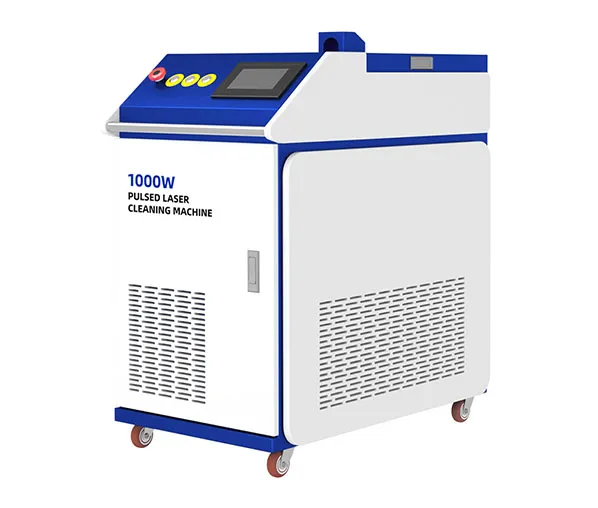
A 1000W pulsed laser cleaning machine is suitable for heavier cleaning tasks and larger workpieces. It is stronger, faster, and more expensive. Choose it when cleaning speed and workload justify the investment.
Before choosing a laser cleaner, do not start with the model number. Start with your workpiece. A good supplier should ask about the material, surface layer, cleaning area, and working hours before recommending a model.
Please prepare the following details:
With this information, Jobon Laser can help recommend a suitable CW or pulsed laser cleaning solution. We can also support sample testing, so you can see the actual cleaning effect before purchase.
Jobon Laser is a factory-direct supplier specializing in the R&D and manufacturing of industrial laser equipment. We provide global B2B customers with laser welding, laser cleaning, laser marking, and laser cutting machines, as well as customized turnkey solutions.
For laser cleaning buyers, we support both CW and pulsed cleaning needs. Whether you need a compact pulsed laser cleaner for molds or a stronger CW laser cleaning machine for heavy rust removal, our team can help you select the right configuration.
Jobon Laser serves metal fabrication workshops, sheet metal and hardware factories, automotive parts manufacturers, home appliance and electronics producers, jewelry processors, engineering contractors, system integrators, distributors, and importers.
Our support includes:
If your production line also needs welding, marking, or cutting, you can explore our related solutions:
CW laser cleaning is better for fast removal of heavy rust, thick paint, and large steel surfaces. Pulsed laser cleaning is better for precision cleaning, mold cleaning, thin parts, and applications that need lower heat impact. The better choice depends on your material and cleaning goal.
A pulsed laser cleaning machine usually uses more precise laser control and is designed for lower heat impact and better surface protection. It is often more expensive than a CW machine, but it can be more suitable for high-value parts, molds, and precision cleaning.
In many configurations, CW laser cleaning machines are cheaper in machine price. However, CW machines are usually bigger and heavier, so shipping cost may be higher. Buyers should compare total cost, not only equipment price.
For light rust, 100W, 200W, or 300W pulsed laser cleaning machines may be suitable. If the rust area is small and precision matters, choose 100W or 200W. If you need better speed and portability, 300W is a good choice.
For thick rust, you may choose a CW laser cleaning machine or a higher-power pulsed machine such as 500W or 1000W. The final choice depends on the rust thickness, base material, cleaning area, and required speed.
For many workshops, yes. A 300W pulsed laser cleaning machine is suitable for general rust removal, oxide cleaning, surface preparation, and portable cleaning tasks. For large-area or heavy rust cleaning, 500W, 1000W, or CW machines may be better.
In many industrial surface cleaning tasks, laser cleaning can reduce or replace chemical cleaning. It does not require chemical cleaning solution and can reduce waste handling. However, the best method still depends on the material, contaminant, and production process.
Yes. Sample testing is strongly recommended. It helps confirm cleaning speed, surface effect, heat impact, and whether the selected laser power is suitable for your real workpiece.
If you are not sure whether to choose CW or pulsed laser cleaning, send us your material and cleaning requirements. Our team can help you compare machine type, power level, cleaning speed, machine cost, shipping cost, and expected cleaning result.
To get a faster recommendation, please send:
Jobon Laser can help you choose a suitable laser cleaning machine and provide sample testing support before ordering.
2026-09
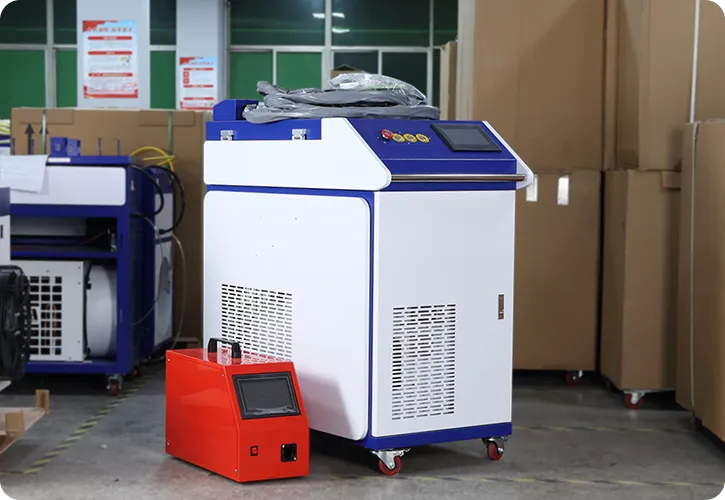
Choosing between a 1500W vs 2000W vs 3000W vs 6000W laser welding machine should start wit…
2026-09
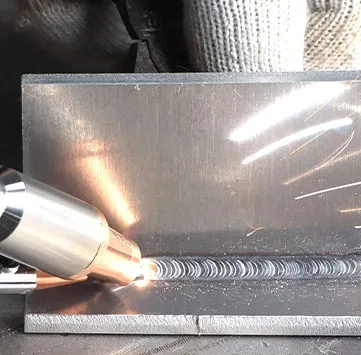
Shielding gas consumption in laser welding can be reduced by optimizing gas flow, checking…
Wir werden Ihnen innerhalb von 24 Stunden antworten. Wenn für dringenden Fall, fügen Sie bitte WhatsApp/WeChat: +86 18053185411,.
*Wir respektieren Ihre Vertraulichkeit und alle Informationen sind geschützt.
Wir verwenden Ihre Daten nur zur Beantwortung Ihrer Anfrage und senden Ihnen niemals unaufgefordert E-Mails oder Werbenachrichten.