







Industrial Laser Marking Machine Buying Guide: How to Choose the Right Fiber, UV or CO₂ Laser Marker
Choosing an industrial laser marking machine can be difficult when different materials, ma…
 17:18
Choosing an industrial laser marking machine can be difficult when different materials, marking requirements and production workflows call for different equipment. The wrong choice may lead to poor contrast, slower production or unnecessary costs. Understanding the available laser technologies and machine structures helps manufacturers select equipment that fits their actual needs.
The best آلة الوسم بالليزر depends on what you need to mark and how you produce it. Fiber lasers are commonly used for metal parts, UV lasers suit many fine-marking and heat-sensitive material applications, and CO₂ lasers are widely used for non-metal materials. Handheld, desktop, cabinet and flying laser marking systems support different workflows, from individual components to continuous production lines.
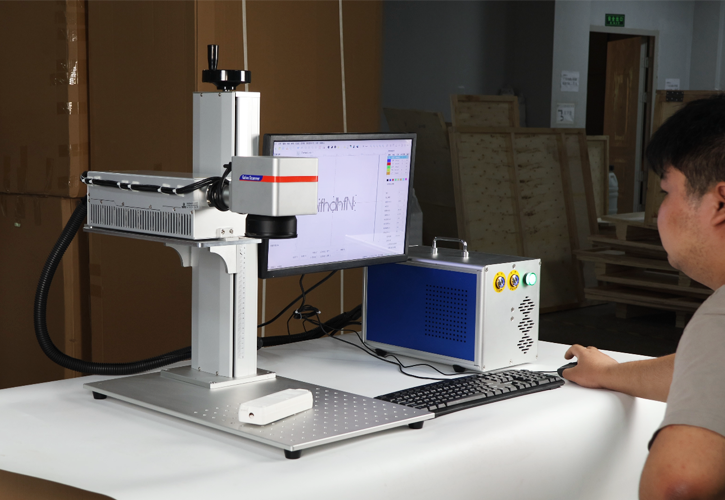
An industrial laser marking machine uses a focused laser beam to create text, logos, serial numbers, barcodes, QR codes and other identification marks on a material’s surface. Unlike inkjet printers or contact engraving tools, laser marking is a non-contact process. It can produce precise and repeatable marks without applying physical cutting pressure to the workpiece.
The laser source generates light that is directed through an optical system toward the marking area. In many systems, a galvanometer scanning head moves the beam across a programmed pattern. Depending on the material and laser settings, the surface may undergo a color change, oxidation, coating removal or limited material removal.
The marking result depends on several connected factors: laser wavelength, optical spot size, output power, pulse characteristics, marking speed and surface condition. A machine that produces a clear laser mark on stainless steel may not produce the same result on transparent plastic or glass.
Industrial laser marking is used for both product branding and traceability. Manufacturers may need to mark permanent identification information on individual components, while packaging operations may require high-speed coding directly on moving products.
The key is to select a laser marking system around the intended application rather than assuming one laser technology will work equally well on every material.
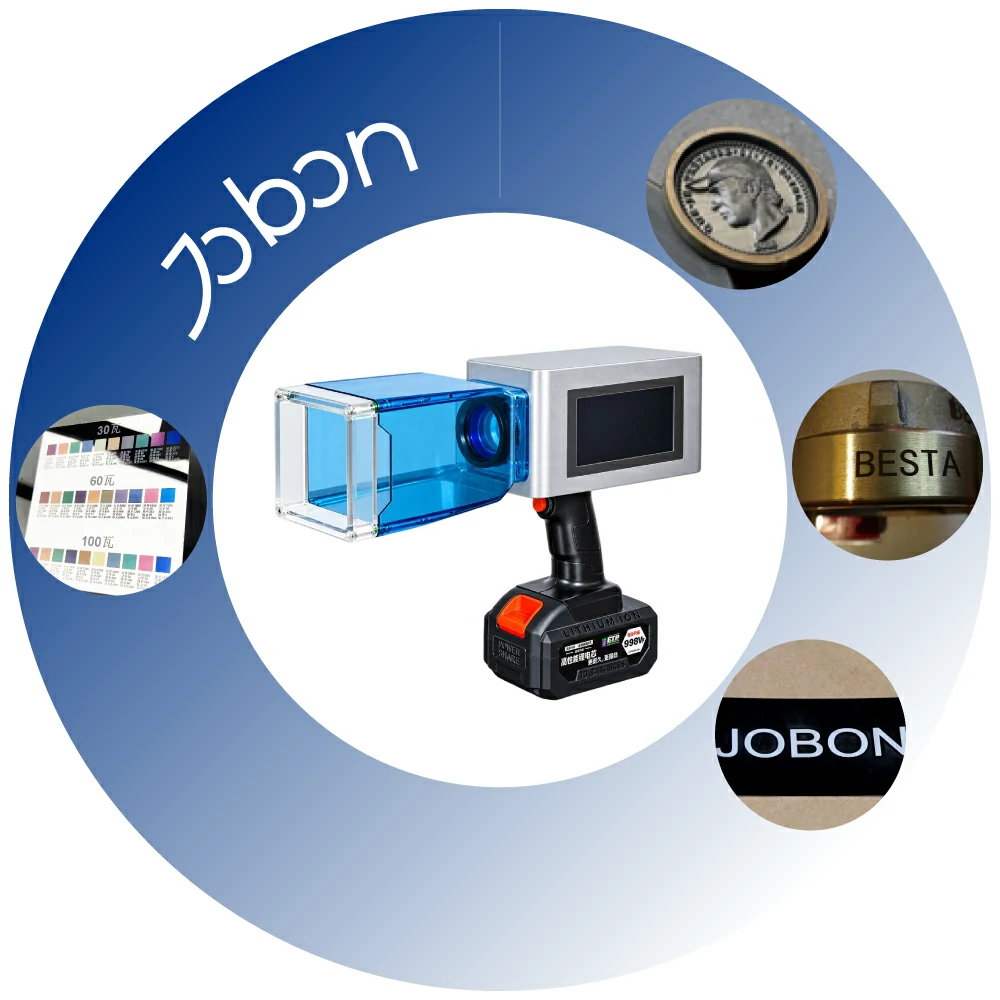
Fiber, UV and CO₂ systems are the main types of laser marking technology used across Jobon’s industrial marking product range.Each technology interacts differently with materials because of its wavelength and operating characteristics.
| Comparison | Fiber Laser Marking | UV Laser Marking | CO₂ Laser Marking |
| Common wavelength | Approximately 1064 nm | Approximately 355 nm | Approximately 10.6 μm |
| Main material focus | Metals and selected plastics | Plastics, glass, films and sensitive materials | Wood, leather, acrylic, paper and other suitable non-metals |
| Typical applications | Serial numbers, metal engraving, industrial traceability | Fine text, micro-marking, electronic components, packaging | Product branding, non-metal engraving, packaging codes |
| Main selection advantage | Strong suitability for many metal marking applications | Fine marking with controlled thermal impact | Broad application potential on suitable non-metal materials |
| Key limitation | Not suitable for every transparent or heat-sensitive material | Results and throughput depend strongly on material and power | Generally not the first choice for bare metal engraving |
Fiber Laser Marking Machine for Metal Parts
A fiber laser marking machine is usually a strong starting point for manufacturers working with stainless steel, carbon steel, aluminum, brass and other suitable metallic materials and alloys.
Fiber laser marking can produce serial numbers, identification text, product logos and machine-readable codes. With suitable settings, it can also support surface engraving and certain deeper engraving applications.
Jobon’s fiber marking range includes desktop, split, cabinet, handheld and flying configurations. This allows buyers to select equipment based on both the material and the production environment.
For example, a desktop fiber laser engraver may suit repeated marking of individual machined components, while a handheld machine offers greater flexibility for large or difficult-to-move metal parts.
A آلة الوسم بالليزر بالأشعة فوق البنفسجية uses a shorter wavelength that can be particularly useful for fine marking on materials sensitive to heat.
Applications may include selected plastics, glass, coated surfaces, thin films and electronic components. The smaller optical interaction area achievable in suitable configurations can support detailed text and compact graphics.
Jobon’s product range includes cabinet, desktop, split, handheld and flying UV marking equipment. Buyers should choose between these structures according to the material, required marking result and production method.
UV laser marking is not automatically the best solution for every plastic. Different polymers and additives respond differently, so testing the exact material remains important.
CO₂ laser marking is widely used on suitable non-metal materials, including wood, leather, paper, acrylic and selected packaging substrates.Jobon’s CO₂ product range includes desktop, split, cabinet and flying marking machines. The published Split CO₂ and Cabinet CO₂ product information lists 40W, 60W and 100W configurations.
For manufacturers engraving product branding on wood or leather, a CO₂ laser engraving machine may be more suitable than a standard fiber laser marker. For packaging operations, a flying CO₂ configuration may provide a route to continuous coding.The most important rule is simple: match the laser wavelength to the material before comparing power or machine price.
Material compatibility is one of the most important purchasing considerations.A material described simply as “metal” or “plastic” may have very different marking requirements depending on its grade, coating, composition and surface finish.
| Material | Recommended Technology to Evaluate | Typical Marking Application |
| الفولاذ المقاوم للصدأ | Fiber laser | Logos, serial numbers, identification codes |
| Carbon steel | Fiber laser | Industrial part marking and traceability |
| ألومنيوم | Fiber laser | Component codes, branding and equipment identification |
| ألومنيوم مؤكسد | Fiber laser | Surface marking and high-contrast identification |
| Copper or brass | Fiber or specialized marking technology | Industrial labels and precision markings |
| Selected engineered plastics | UV or compatible fiber laser | Product codes, fine text and electronic parts |
| زجاج | UV or suitable CO₂ process | Logos, fine marks and decorative applications |
| خشب | CO₂ laser | Branding, patterns and decorative engraving |
| جلد | CO₂ laser | Logos and product customization |
| Paper and packaging materials | CO₂ or UV | Dates, batch codes and product identification |
| Transparent crystal | Crystal internal engraving system | Internal patterns and decorative images |
For example, fiber laser marking on anodized aluminum can create useful identification marks, but color and contrast depend on the anodized layer and processing settings.Similarly, a UV laser may offer precise laser marking on selected plastic products, but the final effect depends on the polymer formulation and any additives.
For buyers requesting permanent marking, it is helpful to define what permanence means in the intended application. A label used on indoor electronic equipment may face different conditions from a metal part exposed to cleaning chemicals, abrasion or outdoor weather.A suitable sample test should therefore assess not only visual appearance but also the durability and readability required in service.
Industrial buyers must also decide how the marking equipment will fit into their manufacturing workflow.
| Machine Structure | Main Operating Characteristic | Best-Fit Production Requirement |
|---|---|---|
| Handheld Laser Marking Machine | Marking head moves to the workpiece | Large, heavy or installed components |
| Desktop Laser Marking Machine | Compact fixed workstation | Small and medium parts, repeated marking |
| ماكينة الوسم بالليزر المنقسمة | Separate equipment components | Flexible workshop installation |
| Cabinet Laser Marking Machine | Dedicated cabinet-style workstation | Controlled marking stations and production areas |
| ماكينة الوسم بالليزر الطائر | Dynamic marking on moving products | Continuous production lines |
| Crystal Internal Engraving Machine | Internal marking of transparent material | Decorative crystal and glass products |
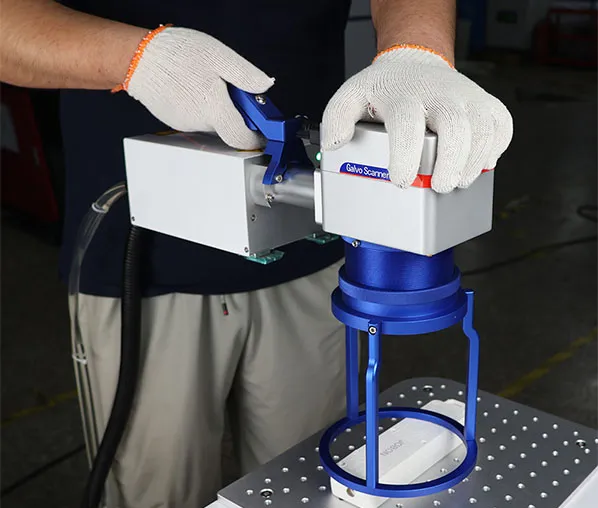
A handheld laser marking machine is useful when moving the workpiece would be inconvenient.Large machinery frames, metal structures and installed equipment may be easier to mark with a portable handheld system than with a fixed workstation.
Jobon offers portable handheld fiber marking equipment and a Mini Handheld Fiber Laser Marking Machine. The mini model is listed with 10W and 20W options, an integrated touchscreen and an optional battery configuration.This makes the product range relevant to buyers evaluating portable industrial laser marking systems.
However, handheld marking still requires suitable positioning and laser safety controls. Portability should not be confused with unrestricted operation in an open workplace.
Buyers often begin by comparing 20W, 30W, 50W and 100W fiber laser marking machines. Power matters, but it does not independently determine marking quality or production capacity.
For example, a 20W fiber laser may be suitable for ordinary surface identification on compatible metal parts. Applications requiring deeper material removal or shorter cycle times may justify evaluating higher-power equipment.
The selected laser source, pulse characteristics, scanning system and focusing optics must still match the application.Jobon’s published product information includes the following options for specific machine types.
| Jobon Marking Product | Published Power Options | Important Selection Detail |
|---|---|---|
| Mini Handheld Fiber | 10W / 20W | Compact integrated design |
| Portable Handheld Fiber | 20W / 30W / 50W | Separate handheld head and control box |
| Cabinet Fiber | 20W / 30W / 50W / 100W | Fixed cabinet-style structure |
| Split CO₂ | 40W / 60W / 100W | 10.6 μm CO₂ technology |
| Cabinet CO₂ | 40W / 60W / 100W | Non-metal marking applications |
The specific model and current configuration should be confirmed before quotation.
Not necessarily.A higher-power system may offer more processing capability under suitable conditions, but a fine identification mark does not always benefit from maximum power.
When comparing machines, buyers should specify:
For deep metal engraving, the requested engraving depth and acceptable cycle time are especially important.A 20W fiber laser, a higher-power fiber marker and a MOPA fiber laser marking machine should not be treated as interchangeable products simply because each can process metal under some conditions.
Not all fiber laser sources have the same pulse-control capabilities.A conventional pulsed fiber laser marking system is widely used for ordinary metal identification. MOPA fiber laser technology can provide more flexibility over pulse characteristics in suitable equipment, which may be valuable for applications involving specific marking finishes or more controlled surface processing.
However, MOPA is a laser-source configuration, not a general feature of every fiber marking machine.Buyers searching for a MOPA fiber laser engraver, a 30W MOPA system or a 100W JPT M7 MOPA fiber laser should confirm the exact source model before assuming that a machine supports those operating modes.
Surface marking focuses on producing visible identification while limiting material removal.
Deep engraving intentionally removes more material to form a recessed pattern. This generally requires different processing parameters and can increase cycle time.
For industrial buyers, the required engraving depth should be specified numerically where possible. Terms such as “deep” or “permanent” are not enough to select a machine.
Jobon’s available fiber marking products can be evaluated according to these requirements, but any special MOPA source, color-marking process or deep-engraving performance must be confirmed for the actual configuration.
Product traceability is one of the most commercially important applications for industrial laser marking.Manufacturers need identification that connects physical components to production records, quality checks, assembly information or shipment batches.
A laser marking system can create the physical identification mark. The structure and content of that identification depend on the customer’s traceability process.
Common marking content includes:
For automotive components, machinery parts and electrical equipment, readable identification can help employees track components through manufacturing and service.
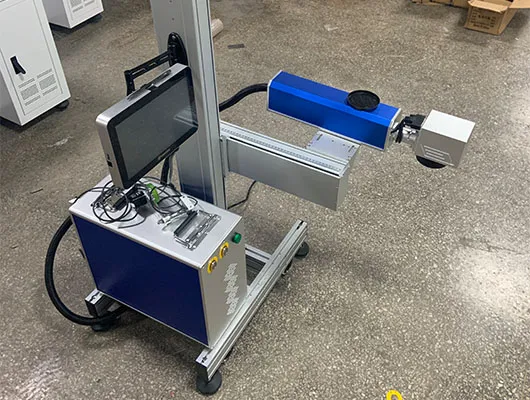
Yes, flying marking technology is designed for applications where products move during coding.Jobon’s Flying Fiber, Flying UV and Flying CO₂ products provide different technology options for continuous-production workflows.
When evaluating production-line integration, buyers should check how marking content is supplied, how the product position is detected and how the machine communicates with other equipment.A flying laser marker may support production-line coding, but integration with a specific PLC, database, MES or vision system should not be assumed without checking the actual controller and interface.
Laser marking, laser engraving and dot peen marking are often discussed together, but they do not describe identical processes.
Laser marking is the broad term for creating identification using a laser beam. Laser engraving is a process that removes material to produce a recessed pattern. Dot peen marking uses a mechanical stylus to create a series of indentations.
| Process | How It Creates the Mark | Main Consideration |
| Laser Surface Marking | Changes surface appearance or removes a limited amount of material | Contrast, readability and material response |
| Laser Engraving | Removes material to create depth | Depth, processing time and surface finish |
| Dot Peen Marking | Mechanically indents the surface | Mechanical access, noise and part stability |
| Inkjet Coding | Deposits ink on the surface | Consumables, adhesion and environmental conditions |
A laser marking machine for metal may be attractive when manufacturers need detailed logos, fine text or machine-readable codes without physical contact.Dot peen marking may remain relevant when the specification requires mechanically indented identification.Inkjet printers may suit some packaging applications where non-contact printing and production-line integration are important.
For B2B purchasing decisions, the best comparison uses actual parts and evaluates mark quality, cycle time, maintenance requirements and total cost of ownership.
An industrial laser marking machine should fit the factory’s workflow as well as its technical marking requirements.A machine may successfully engrave one demonstration sample yet perform poorly when the material changes, the required marking area becomes larger or production volume increases.Before comparing quotations, buyers should prepare a clear application specification.
| Information to Provide | Why It Matters |
| Material type and grade | Determines which laser technology should be evaluated |
| Workpiece dimensions | Helps select handheld, desktop or fixed equipment |
| Surface condition | Affects contrast and marking response |
| Marking content | Determines text, logo and code requirements |
| Marking dimensions | Helps select the optical marking field |
| Required depth or color | Influences source and process selection |
| Production quantity | Helps estimate practical cycle-time requirements |
| Operating environment | Affects machine installation and safety planning |
| Automation requirements | Determines whether flying marking or other integration is needed |
Selecting a reliable laser equipment supplier is about more than comparing machine specifications.Industrial buyers also need support with material compatibility, equipment configuration, installation requirements and ongoing operation.
جوبون Laser is a China-based industrial laser equipment manufacturer specializing in laser marking, welding, cleaning, cutting and customized laser solutions.Its marking product range includes fiber, UV and CO₂ machines, with handheld, desktop, split, cabinet and flying configurations for different industrial applications.
The company serves manufacturers, industrial equipment distributors and buyers seeking equipment for metal processing, electronics, machinery, hardware and related industries.For OEM/ODM projects, the selection process should focus on the actual production requirement. Buyers can discuss machine structure, marking area, laser power, material compatibility and potential integration needs rather than relying only on a standard equipment description.
If your factory marks metal components, a fiber laser may be the first technology to evaluate. If you process selected heat-sensitive plastics or require detailed marking, a UV system may be more suitable. If you engrave wood, leather or other compatible non-metal materials, a CO₂ system may be the better starting point.
What is the best laser marking machine for metal?
A fiber laser marking machine is generally a good starting point for stainless steel, carbon steel, aluminum and other compatible metals. The final choice depends on the required marking contrast, engraving depth, component dimensions and production speed.
Can a laser marking machine engrave plastic?
Yes, certain laser technologies can mark compatible plastics. UV marking is often evaluated for fine or heat-sensitive plastic products, while fiber and CO₂ systems may also work with selected formulations. Material testing is recommended before purchase.
What is the difference between fiber and UV laser marking?
Fiber laser marking commonly uses near-infrared light and is widely applied to metals. UV laser marking uses shorter-wavelength light and can be particularly useful for fine marking on selected plastics, glass and sensitive surfaces. The correct choice depends on material response and the desired result.
Can a 20W fiber laser marking machine engrave metal?
A 20W fiber laser can produce identification marks on suitable metal surfaces. However, engraving depth, contrast and processing time depend on the material, source characteristics, optical configuration and marking parameters.
Do I need a MOPA fiber laser marking machine?
MOPA technology may be useful when the application requires particular pulse-control capabilities. It is not necessary for every standard metal identification task. Buyers should confirm whether the selected machine includes a suitable MOPA laser source before ordering.
Can a flying laser marking machine mark products without stopping the production line?
Flying marking equipment is designed to mark products during continuous movement. Jobon offers Flying Fiber, Flying UV and Flying CO₂ marking products. The achievable production speed and code quality depend on the application, conveyor conditions and selected configuration.
Is a handheld laser marking machine suitable for industrial use?
Handheld marking systems can be suitable for industrial applications involving large, heavy or installed components. They provide flexible positioning but still require suitable laser safety controls and consistent positioning for repeatable results.
How do I choose the correct marking area?
Measure the largest marking pattern you need, including text, logos and codes. Then select an optical marking field that accommodates the design while maintaining the required detail and clarity. The largest available marking field is not automatically the best option for fine marking.
2026-11
Choosing an industrial laser marking machine can be difficult when different materials, ma…
2026-11
To compare two fiber laser power options, run the same part or sheet layout on both config…
سنرد عليك في غضون 24 ساعة. إذا كانت الحالة طارئة، يُرجى إضافة واتساب/وي شات: +86 18053185411,.
*نحن نحترم سريتك وجميع معلوماتك محمية.
لن نستخدم معلوماتك إلا للرد على استفسارك ولن نرسل أبداً رسائل بريد إلكتروني غير مرغوب فيها أو رسائل ترويجية.